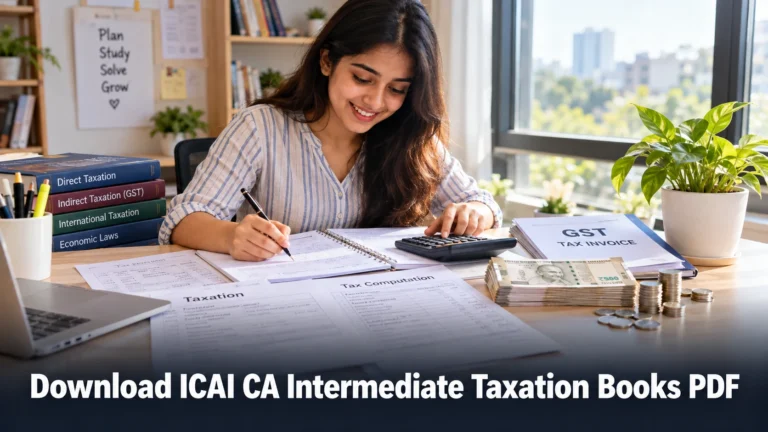
ICAI’s Board of Studies publishes the official CA Intermediate Taxation Study Material as free PDFs, covering both Income-tax Law and Goods and Services Tax across nine and fifteen chapters respectively. This page has the section-wise marks weightage plus direct download links to every chapter and unit, for both ICAI editions currently live.
CA Intermediate Taxation: Syllabus and Marks Weightage
This weightage applies to both editions of the Study Material linked below, since the topic list is identical in each.
Section A: Income-tax Law (50 Marks)
| Contents | Section | Weightage |
|---|---|---|
| Basic Concepts; Residential status and scope of total income | I | 10%-20% |
| Heads of income and the provisions governing computation of income under different heads | II | 25%-30% |
| Provisions relating to clubbing of income, set-off or carry forward and set-off of losses, deductions from gross total income | III | 15%-20% |
| Advance Tax, Tax deduction at source and tax collection at source; Provisions for filing return of income and self-assessment | IV | 15%-20% |
| Computation of total income and income-tax payable by an individual under the alternative tax regimes under the Income-tax Act, 1961 to optimise tax liability | V | 20%-25% |
Section B: Goods and Services Tax (50 Marks)
| Contents | Section | Weightage |
|---|---|---|
| GST Laws: An introduction including Constitutional aspects | I | 0%-5% |
| Levy and collection of CGST and IGST, basic concepts of classification, place of supply, time of supply, value of supply, input tax credit, and computation of GST liability | II | 50%-80% |
| Registration; Tax invoice, Credit and Debit Notes, E-way bill; Accounts and Records; Payment of tax; Returns | III | 20%-45% |
Objective, per ICAI: to develop an understanding of the provisions of income-tax law and goods and services tax law, and to acquire the ability to apply such provisions to solve problems and address application-oriented issues.
Download ICAI Study Material for Income-tax Law
ICAI currently has two editions of this Study Material live on its portal at the same time. Both cover the same nine chapters, so pick whichever edition matches the physical or PDF copy you already have, rather than mixing chapters from both.
Edition 1: Applicable for May 2026 Exam Onwards
This edition applies to the May 2026, September 2026, and January 2027 attempts.
Module 1
Chapter 1: Basic Concepts
Chapter 2: Residence and Scope of Total Income
Chapter 3: Heads of Income — Unit 1: Salaries, Unit 2: Income from House Property, Unit 3: Profits and Gains of Business or Profession, Unit 4: Capital Gains, Unit 5: Income from Other Sources
Module 2
Chapter 4: Income of Other Persons included in Assessee’s Total Income
Chapter 5: Aggregation of Income, Set-Off and Carry Forward of Losses
Chapter 6: Deductions from Gross Total Income
Chapter 7: Advance Tax, Tax Deduction at Source and Tax Collection at Source
Chapter 8: Provisions for Filing Return of Income and Self Assessment
Chapter 9: Income Tax Liability: Computation and Optimisation
Edition 2: Relevant for May 2027 and Onwards Examination
This edition applies to the May 2027 attempt and every attempt after it, until ICAI issues a further update.
Module 1
Chapter 1: Basic Concepts
Chapter 2: Residential Status and Scope of Total Income
Chapter 3: Heads of Income — Unit 1: Salaries, Unit 2: Income from House Property, Unit 3: Profits and Gains of Business or Profession, Unit 4: Capital Gains, Unit 5: Income from Other Sources
Module 2
Chapter 4: Income of Other Persons included in Total Income of Assessee
Chapter 5: Set-Off or Carry Forward and Set-off of Losses
Chapter 6: Deductions from Gross Total Income
Chapter 7: Tax Deduction or Collection at Source and Advance Tax
Chapter 8: Provisions for Filing Return of Income and Self Assessment
Chapter 9: Income Tax Liability: Computation and Optimisation
Download ICAI Study Material for Goods and Services Tax
Both editions of the GST Study Material cover the same fifteen chapters with identical titles.
Edition 1: Applicable for May 2026 Exam Onwards
Module 1
Chapter 1: GST in India: An Introduction
Chapter 2: Supply under GST
Chapter 3: Charge of GST
Chapter 4: Place of Supply
Chapter 5: Exemptions from GST
Chapter 6: Time of Supply
Chapter 7: Value of Supply
Module 2
Chapter 8: Input Tax Credit
Chapter 9: Registration
Chapter 10: Tax Invoice; Credit and Debit Notes; Electronic Way Bill
Chapter 11: Accounts and Records
Chapter 12: E-Way Bill
Chapter 13: Payment of Tax
Chapter 14: Tax Deduction at Source and Collection of Tax at Source
Chapter 15: Returns
Edition 2: Relevant for May 2027 and Onwards Examination
Module 1
Chapter 1: GST in India: An Introduction
Chapter 2: Supply under GST
Chapter 3: Charge of GST
Chapter 4: Place of Supply
Chapter 5: Exemptions from GST
Chapter 6: Time of Supply
Chapter 7: Value of Supply
Module 2
Chapter 8: Input Tax Credit
Chapter 9: Registration
Chapter 10: Tax Invoice; Credit and Debit Notes
Chapter 11: Accounts and Records
Chapter 12: E-Way Bill
Chapter 13: Payment of Tax
Chapter 14: Tax Deduction at Source and Collection of Tax at Source
Chapter 15: Returns
Why Two Editions Exist and Which One You Need
ICAI keeps the current edition live for students appearing up to a certain attempt, while already publishing the next print run for later attempts, so both sit on the portal together for a while. We checked topic by topic. The GST chapters are identical in both content and titles across editions. The Income-tax chapters cover the same nine topics in both editions too, but a few chapter titles were reworded between editions: Chapter 2 is “Residence and Scope of Total Income” in Edition 1 and “Residential Status and Scope of Total Income” in Edition 2, Chapter 5 is “Aggregation of Income, Set-Off and Carry Forward of Losses” in Edition 1 and “Set-Off or Carry Forward and Set-off of Losses” in Edition 2, and Chapter 7 reorders its title from “Advance Tax, Tax Deduction at Source and Tax Collection at Source” in Edition 1 to “Tax Deduction or Collection at Source and Advance Tax” in Edition 2. The underlying content and weightage are unaffected by this rewording.
If your physical book or PDF says “Applicable for May 2026 Exam Onwards” on the cover, use Edition 1. If it says “Relevant for May 2027 and Onwards Examination,” use Edition 2.
Using This Alongside Your Revision
Once you have worked through a chapter from the Study Material, test yourself with our CA Inter RTP for revision questions, and our CA Inter MTP for full timed mock exams on the same syllabus.
If you are planning your revision schedule around this syllabus, our guide on how to revise the CA syllabus in 15 days breaks the process down step by step.
Frequently Asked Questions
What is the marks weightage for CA Intermediate Taxation?
Income-tax Law carries 50 marks across five sections (10-30% each), and GST carries 50 marks across three sections, with Section II alone worth 50-80% of the GST paper, as detailed in the tables above.
Is the CA Intermediate Taxation syllabus changing for May 2027?
The topics and weightage are identical between editions. A few Income-tax chapter titles were reworded in Edition 2 without changing the underlying content, and the GST chapters are unchanged.
Where do I download the official ICAI Study Material for Taxation?
Every chapter and unit PDF on this page is hosted directly on caharshgupta.com, downloaded from ICAI’s official BoS Knowledge Portal so the links stay stable and won’t break if ICAI reorganises its own site.
Should I use the RTP or the Study Material first?
Study Material first. It teaches the concepts in full. RTP and MTP come after, once you already understand a topic, to practice applying it under exam conditions.
Source: ICAI BoS Knowledge Portal, Study Material (New Scheme), Intermediate and Section-wise Weightages.