
CA Inter Group 1 vs Group 2 — Which to Attempt First? The Complete Strategy Guide
The most common CA Inter dilemma — answered honestly, with real data.
By Harsh Gupta | HG Virtuals
This question comes up in every CA Inter student’s journey — usually around the time of exam form filling, when the decision can no longer be delayed.
Do I attempt both groups together? Or focus on one group first? If one group, which one — Group 1 or Group 2?
Most students make this decision based on what their friends are doing, or what their coaching faculty recommends in a general sense. Very few make it based on a clear understanding of their own situation.
This blog gives you the framework to make that decision correctly — for yourself.
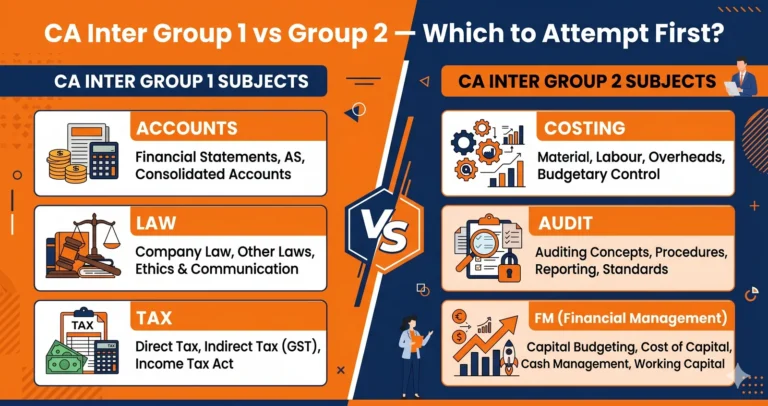
First — What Are the Two Groups?
CA Inter Group 1:
- Paper 1 — Advanced Accounting
- Paper 2 — Corporate & Other Laws
- Paper 3 — Taxation (Income Tax + GST)
CA Inter Group 2:
- Paper 4 — Cost & Management Accounting
- Paper 5 — Auditing & Ethics
- Paper 6 — Financial Management & Strategic Management
Each group has 3 papers. To clear a group, you need minimum 40% in each paper and 50% aggregate across the group.
The Pass Percentage Reality
Before deciding strategy, look at what the data says.
| Session | Both Groups | Group 1 Only | Group 2 Only |
|---|---|---|---|
| January 2026 | 9.39% | 13.96% | 15.54% |
| September 2025 | ~10% | ~9.43% | ~27.14% |
| January 2025 | 14.07% | 14.17% | 22.16% |
Two things are clear from this data:
Group 2 consistently has a higher pass percentage than Group 1. This is not because Group 2 is easier — it is because Group 2 subjects, while demanding, tend to have more predictable patterns and slightly more scoring opportunities.
Attempting both groups simultaneously results in the lowest pass percentage. Only around 9 to 14% of students who attempt both groups clear both in the same attempt. This is the hardest outcome — not because students are unprepared, but because passing 6 papers simultaneously requires a level of consistent preparation across all subjects that most students cannot maintain.
This does not mean you should not attempt both. It means you should attempt both only when you are genuinely ready for both.
Group 1 vs Group 2 — The Subject Nature Difference
Understanding what each group actually demands helps you decide where to start.
Group 1 — Characteristics
Advanced Accounting is the most demanding subject in Group 1. It covers a wide range of accounting standards, company accounts, and practical scenarios. Students who are weak in fundamentals from Class 12 or CA Foundation accounts will struggle here.
Corporate & Other Laws is theory-heavy and requires retention of sections, penalties, and procedures. It is not a difficult subject conceptually — but it is vast, and forgetting is easy without regular revision.
Taxation covers both Income Tax and GST — two subjects within one paper. It is application-based, with frequent amendments. Strong conceptual understanding plus regular practice is essential.
Group 1 rewards: Students who are strong in accounting fundamentals, enjoy working with numbers, and are comfortable with application-based questions.
Group 1 challenges: The accounting paper is unforgiving if your basics are weak. Tax requires staying updated with amendments.
Group 2 — Characteristics
Cost & Management Accounting is largely numerical — standard costing, marginal costing, budgets, variances. Students who enjoy maths and methodical problem-solving tend to score well here.
Auditing & Ethics is theory-based but more structured than Law. The Standards on Auditing have a logical framework, and students who understand the logic — not just memorise — do well.
Financial Management & SM has two parts — FM (numerical, application-based) and SM (theory). FM requires formula clarity and problem-solving. SM is theory-heavy and often underestimated.
Group 2 rewards: Students who are methodical, enjoy structured problem-solving, and are disciplined about theory revision.
Group 2 challenges: FM & SM is where many Both Groups attempts fail — students underestimate SM theory and run out of time for it.
The Decision Framework — Which Should YOU Attempt?
Scenario 1: You are a fresh CA Foundation passer with 8 to 10 months to go
Attempt both groups together — but plan smartly.
With 8 to 10 months of dedicated preparation, both groups are achievable. However, do not study them sequentially — do not complete all Group 1 classes first and then move to Group 2. That approach kills Group 1 revision time.
Instead, study all subjects simultaneously — rotate between Group 1 and Group 2 subjects every day. Your daily schedule should touch both groups every single day.
Scenario 2: You have 4 to 6 months to go
Attempt one group — whichever is more complete.
With less than 6 months, attempting both groups is high-risk. Focus on the group whose classes you have completed and where your revision is more advanced.
If both groups are equally incomplete — choose Group 2 first. The higher historical pass percentage gives you a slightly better statistical edge for a focused single-group attempt.
Scenario 3: You attempted both groups and cleared one, need to clear the other
Focus entirely on the remaining group.
You have already cleared one group — treat the remaining group as a standalone exam. Your energy and time go entirely to the 3 pending papers. Do not revisit the cleared group.
Scenario 4: You have strong accounts and tax fundamentals
Consider starting with Group 1.
Group 1 lays the conceptual foundation that makes CA Final easier. FR (Financial Reporting) at CA Final level builds directly on Advanced Accounting. If you clear Group 1 early and build strong fundamentals, your CA Final journey becomes meaningfully easier.
Scenario 5: You are weak in accounts but strong in theory
Consider starting with Group 2.
Group 2’s theory-heavy subjects (Audit, SM) and structured numericals (Costing, FM) may be more achievable for students who are not confident in accounting. A Group 2 clear builds momentum and gives you 6 extra months to strengthen accounts fundamentals before tackling Group 1.
The Registration Trap — One Thing Everyone Gets Wrong
Here is something almost nobody tells you about the both-groups-vs-single-group decision.
Always register for both groups, even if you plan to attempt only one.
ICAI allows you to register for both groups but appear for only one during the exam. The registration fee for both groups together is lower than registering each group separately at different times.
So the decision about whether to appear for one group or both is separate from the registration decision. Register for both — then decide closer to the exam which to actually attempt.
This gives you maximum flexibility without extra cost.
The Set-Off Advantage — Why Both Groups Can Be Worth It
There is one significant advantage to attempting both groups together that many students overlook.
ICAI allows mark set-off within a group. If you score 55 in Paper 1 and 45 in Paper 2 and 50 in Paper 3 — your Group 1 aggregate is 150/300 = 50%, and you pass even though Paper 2 was close to the minimum.
This set-off only works within a group — not across groups. So appearing for both groups does not create a cross-group set-off. Each group must independently meet the 50% aggregate and 40% per-paper requirements.
The set-off benefit means that if you are strong in 2 of the 3 subjects in a group, your strong subjects can carry the weaker one — as long as you meet the minimum 40% per paper.
Our Honest Recommendation
Based on pass percentage data, subject nature, and real student outcomes:
If you have 8+ months and complete preparation: Attempt both groups together — but study them simultaneously, not sequentially.
If you have 4 to 6 months: Attempt one group — whichever is more prepared.
If you are choosing between Group 1 and Group 2 as your first attempt: Group 2 is statistically more forgiving. But if your accounts fundamentals are strong — Group 1 builds a better foundation for CA Final.
Most importantly: Do not make this decision based on what your batch is doing. Make it based on your own preparation level, your strengths, and how much time you realistically have.
The right answer is always the one that gives you the highest probability of passing — not the one that sounds most ambitious.
Written by Harsh Gupta — CA Educator & Founder, HG Virtuals Use our free CA Study Planner and CA Revision Planner at caharshgupta.com to build your preparation schedule for either group.
Tags: CA Inter Group 1 vs Group 2, CA Inter Strategy, CA Inter Both Groups, CA Inter Single Group, CA Inter September 2026, HG Virtuals